
Why animal sequence, minority VHH output, and constrained diversity move the burden downstream
Camelid heavy-chain-only antibodies changed how the field thought about antibody recognition.
Alongside conventional antibodies built from paired heavy and light chains, camelids also produce antibodies without light chains. The binding domain of these heavy-chain-only antibodies, the VHH, can fold independently and recognize an antigen on its own.
That discovery provided the essential natural proof behind the single-domain antibody:
One compact domain can function as a complete binding unit.
Camelid immunization has since become one of the most established routes to VHH discovery. It has produced exceptional binders and helped create an important class of research, diagnostic, and therapeutic molecules.
That success is real.
But the natural system that revealed the format was built to protect a camelid.
It was not built to produce a development-ready human therapeutic.
That distinction creates three separate constraints: the sequence begins as animal, the VHH-bearing response can be a minority output, and the effective diversity available to discovery is narrowed before screening is complete.
Each constraint matters on its own.
Together, they move a substantial part of molecule creation downstream.
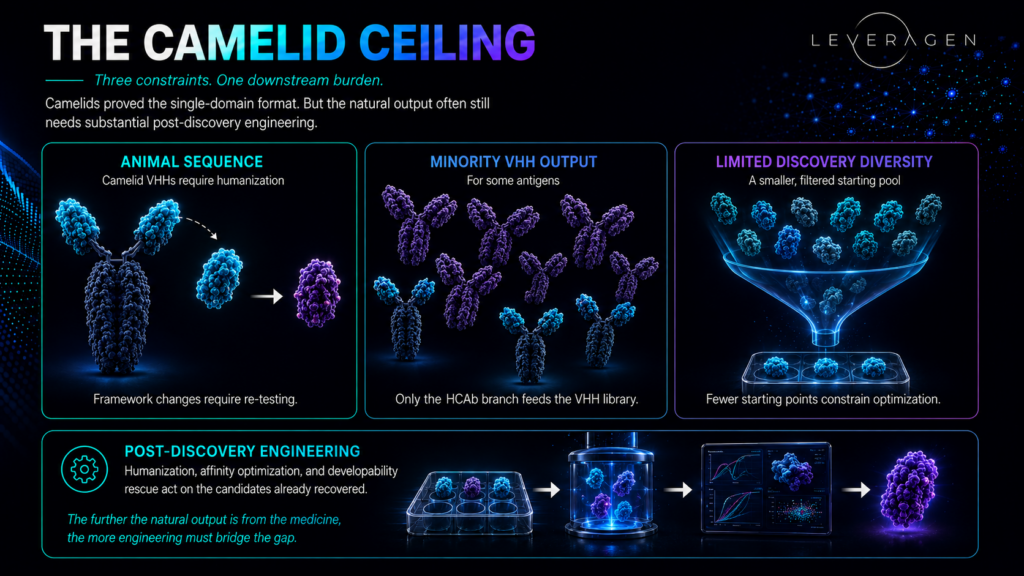
The sequence begins as animal
A VHH recovered from a camelid carries a camelid sequence framework.
That framework is part of a molecule shaped by the animal’s immune system. It supports the binding loops, contributes to the domain’s structure, and helps determine properties such as stability, solubility, expression, and self-association.
For a human therapeutic, the recovered sequence typically cannot be treated as finished.
It often requires human-likeness assessment, humanization, or other sequence optimization to address potential immunogenicity and development concerns.
Humanization is not a cosmetic change.
The binding loops do not operate independently of the framework beneath them. Framework residues help position those loops and can influence the geometry of the antigen-binding surface.
Replacing camelid residues with human counterparts can therefore change more than the sequence label.
Affinity may shift. Stability may decline. Expression may change. Solubility may improve in one variant and worsen in another. A substitution intended to make the molecule more human-like may disturb the structural balance selected during the original immune response.
Every revised molecule must be tested again.
If its properties change, additional variants may need to be designed, expressed, and screened. Some camelid residues may need to be retained. Other positions may require compensating changes.
Humanization can be highly successful.
The limitation is not that a camelid VHH cannot become a suitable human therapeutic. It is that conversion introduces a new design cycle after discovery.
The binder found by the animal and the molecule advanced toward the clinic may not be the same sequence.
The VHH output can be the minority
Camelids do not produce VHH-bearing antibodies in isolation.
Their immune system generates conventional IgG1 antibodies alongside heavy-chain-only antibodies. Conventional antibodies recognize an antigen through a binding surface formed by paired heavy and light chains. Heavy-chain-only antibodies bind without light chains, using one VHH domain on each arm.
Both are complete antibody formats.
Only one supplies natural VHH sequences to a single-domain discovery campaign.
For some antigens, the heavy-chain-only response is strong and produces highly mature VHHs. For others, conventional antibodies take the larger share of the antigen-specific response.
The balance varies by species, animal, antigen, immunization schedule, sampling time, and assay.
A strong total response is not always a strong VHH response.
An immunized animal may generate abundant target-binding antibodies while only a smaller fraction belongs to the heavy-chain-only compartment.
If total antibody titer is used as the principal measure of success, that distinction can remain hidden until discovery begins.
The animal has responded.
But much of the response may be in a format the VHH campaign cannot use.
A minority VHH response does not mean the recovered domains will be weak. A smaller branch can still contain excellent binders.
It does mean that fewer VHH-producing lineages may be available to enter the campaign, even when the overall immune response appears robust.
The ceiling is not the quality any individual VHH can reach.
It is how much of the immune response enters the desired format in the first place.
Diversity narrows before the screen begins
The diversity of an immune response is larger than the diversity captured in a discovery library.
For camelid VHH discovery, the first narrowing occurs at the level of antibody format. Conventional heavy-light-chain antibodies are part of the animal’s response, but they do not contribute intact natural VHH binders.
Only the heavy-chain-only compartment is eligible.
The pool narrows again through biology. Some VHH lineages expand strongly. Others remain rare, disappear during selection, or never become sufficiently represented to be recovered.
The pool narrows again during discovery.
Sampling captures the response at a particular place and time. Amplification, cloning, microbial growth, display, and screening can favor some sequences over others. Rare lineages may be missed. Difficult-to-express domains may be underrepresented. Selection conditions may enrich what performs well in the assay rather than everything the immune system produced.
The final library is a filtered record of one compartment of the response.
This is not a claim that every camelid VHH library is small or uniform.
Camelids can produce substantial sequence diversity, unusual binding geometries, and exceptional domains.
The more precise issue is recovered discovery diversity: how many independent VHH lineages, epitopes, and development alternatives are actually present and accessible when screening begins.
A campaign may still find one strong candidate.
But a program rarely needs affinity alone.
If the leading VHH later shows poor stability, weak expression, nonspecific binding, an unfavorable epitope, or inadequate function, the value of the pool depends on the alternatives behind it.
A deeper pool offers more independent ways to solve the problem.
A narrower pool places more pressure on engineering the candidates already recovered.
The burden moves downstream
The three constraints converge after discovery.
The sequence may need to become more human-like.
Affinity or functional potency may need to improve.
Stability, solubility, expression, specificity, or other developability properties may need to be rescued.
These are familiar and often manageable tasks. Modern protein engineering can create remarkable improvements in a recovered molecule.
But the location of that work matters.
The natural output often becomes the beginning of a second discovery process.
Humanization changes the framework and requires revalidation. Affinity maturation creates and screens new variants. Developability engineering changes residues to address liabilities that may not have been visible during the original campaign.
Each intervention moves the molecule farther from the sequence selected in the animal.
The resulting candidate may be better suited to development.
It is also increasingly the product of deliberate post-discovery design.
This is what makes the engineering artificial: not ineffective or illegitimate, but performed outside the natural immune process.
Instead of mutation and selection occurring within the full biology of an immune response, variants are created and judged through chosen assays. Those assays can measure what a development team knows to test: binding, potency, expression, aggregation, stability, specificity, and other defined properties.
They cannot represent every biological pressure the molecule may encounter.
Engineering is powerful, but it is assay-bounded.
It can explore sequence space around the candidates in hand.
It cannot restore VHH lineages that never expanded in the animal. It cannot recover diversity lost during sampling or library construction. It cannot replay every path of mutation and selection that might have occurred in a more dedicated single-domain response.
Engineering can improve the starting point.
It cannot create the immune history that the starting point never received.
The problem is distance
None of these constraints invalidates camelid VHH discovery.
Camelids remain an important source of single-domain antibodies. Their best VHHs can combine high affinity, useful epitope recognition, compact size, and strong functional activity.
The issue is not whether a camelid can produce an exceptional molecule.
It is how much distance remains between the natural output and the intended medicine.
That distance has three dimensions.
The sequence is animal and often requires humanization.
The VHH-bearing branch may represent only a minority of the antigen-specific response.
The diversity available to discovery is narrowed by both immune biology and the process used to capture it.
The greater the combined distance, the more work moves downstream.
More variants must be designed. More properties must be retested. More tradeoffs must be managed after the original binder has already been selected.
The risk is not simply additional time.
Every change can alter the balance that made the original molecule attractive.
A humanizing substitution may affect affinity. An affinity-enhancing mutation may reduce stability. A solubility improvement may change function. A developability correction may require another round of screening.
The molecule can improve through this process.
But the path becomes one of serial repair and revalidation.
Format matters at the source
Camelids proved that a single domain could perform the complete binding function.
That discovery remains foundational.
But a natural source that reveals a format is not necessarily the ideal architecture for producing a human therapeutic in that format.
If the intended medicine is a human single-domain antibody, the strategic question is not only how to optimize a camelid VHH after discovery.
It is whether discovery can begin closer to the desired endpoint.
A format-native system would direct the immune response toward the single-domain architecture from the beginning. A human sequence framework would reduce the need for later conversion. A dedicated output would avoid dividing the antigen-specific response between usable and unusable antibody formats. Broader recovered diversity would provide more independent starting points before engineering begins.
That does not eliminate development work.
Affinity, function, specificity, stability, expression, and manufacturability still matter. No discovery architecture makes every candidate automatically suitable for a medicine.
It changes what the engineering is asked to do.
Instead of transforming an animal-derived output into the intended therapeutic format, engineering can focus on refining candidates already closer to that format.
Leveragen’s Singularity platform was built around that premise: a light-chain-free mouse in which a human VH repertoire matures in vivo without a parallel paired-antibody arm.
The central idea is simple.
The closer the natural discovery output is to the intended medicine, the less artificial engineering must bridge the gap after discovery.
Camelids proved the single-domain antibody.
The next generation of discovery systems must ask whether the immune response itself can be designed around it.
Format matters in the final medicine.
It also matters in the system that creates the binder.